
Introduction
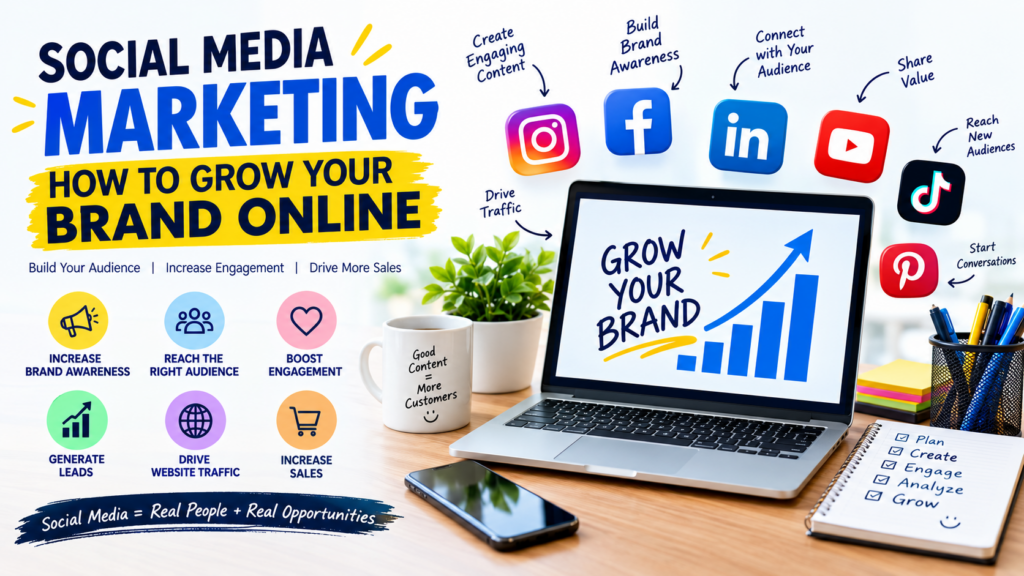
Social media has become an important part of how people discover brands, communicate with businesses, and make purchasing decisions. Platforms such as Instagram, Facebook, LinkedIn, YouTube, and other social networks provide businesses with opportunities to connect directly with their target audience.
This is where social media marketing becomes valuable.
Social media marketing is the process of using social media platforms to promote a brand, connect with customers, share valuable content, build relationships, and achieve business goals.
Whether you are a small business owner, entrepreneur, personal brand, startup, or digital marketer, having a well-planned social media strategy can help you increase brand awareness, reach new audiences, generate leads, and build a stronger online presence.
In this guide, we will explore what social media marketing is, why it matters, the most effective strategies, common mistakes, and how you can use social media to grow your brand online.
What Is Social Media Marketing?
Social media marketing is the use of social media platforms to promote a business, product, service, or personal brand.
It can involve creating and publishing content, engaging with followers, running advertisements, responding to customers, analyzing performance, and building an online community.
Social media marketing can include:
- Image posts
- Short-form videos
- Reels
- Stories
- Educational content
- Promotional posts
- Live videos
- Customer testimonials
- Polls and interactive content
- Paid social media advertising
The main objective is not simply to gain followers. A successful social media strategy focuses on reaching the right audience and creating meaningful interactions that support your business goals.
Why Is Social Media Marketing Important?
Social media gives businesses a direct way to communicate with their audience.
Here are some of the major benefits of social media marketing.
1. Builds Brand Awareness
Regularly sharing useful and engaging content can help people discover and remember your brand.
The more consistently your brand appears in front of the right audience, the greater the opportunity to build recognition.
2. Reaches a Targeted Audience
Social media platforms provide different ways to reach specific audiences based on factors such as interests, demographics, location, and online behavior.
This can make social media useful for both local and global businesses.
3. Increases Audience Engagement
Unlike many traditional forms of advertising, social media allows two-way communication.
Customers can comment on posts, send messages, ask questions, share content, and provide feedback.
4. Generates Leads
Businesses can use social media to direct interested users toward websites, landing pages, contact forms, product pages, or other conversion points.
5. Supports Website Traffic
Useful social media content can encourage people to visit your website, read your blog, explore your products, or learn more about your services.
6. Builds Customer Relationships
Consistent communication and helpful content can help businesses build stronger relationships with their customers.
Major Social Media Platforms for Marketing
Different platforms attract different audiences and content styles. Instead of trying to use every platform, choose the ones that are relevant to your target audience.
Instagram is highly visual and can be useful for:
- Reels
- Stories
- Product showcases
- Educational carousels
- Personal branding
- Behind-the-scenes content
It can be particularly useful for brands that can communicate effectively through images and video.
Facebook provides businesses with opportunities to share content, build communities, communicate with customers, and run advertising campaigns.
It can be useful for local businesses, communities, service providers, and many consumer-focused brands.
LinkedIn is focused on professional networking and can be valuable for:
- B2B marketing
- Professional branding
- Business content
- Industry insights
- Networking
- Recruitment
Professionals can use LinkedIn to demonstrate expertise and build credibility within their industry.
YouTube
YouTube is a major video platform that can be used for:
- Tutorials
- Educational videos
- Product demonstrations
- Reviews
- Interviews
- Long-form content
- Shorts
Video content can help businesses explain complex topics in an engaging way.
10 Effective Social Media Marketing Strategies
1. Define Your Target Audience
Before creating content, understand who you want to reach.
Consider:
- Age group
- Location
- Interests
- Occupation
- Problems
- Needs
- Buying behavior
- Preferred social platforms
For example, a business targeting young audiences may focus more heavily on short-form video platforms, while a B2B company may prioritize LinkedIn.
Understanding your audience helps you create more relevant content.
2. Set Clear Social Media Goals
Your social media activity should have a purpose.
Possible goals include:
- Increase brand awareness
- Generate leads
- Increase website traffic
- Improve engagement
- Increase sales
- Build a community
- Establish industry authority
Use measurable goals whenever possible.
Instead of saying:
“I want more followers.”
You could set a goal such as:
“Increase relevant Instagram followers by 20% over the next three months.”
Clear goals make it easier to measure progress.
3. Create Valuable Content
Content is at the center of social media marketing.
Your content should provide something useful to your audience.
You can create:
- Educational posts
- Tips and tutorials
- Industry insights
- Infographics
- Customer stories
- Product demonstrations
- Frequently asked questions
- Behind-the-scenes content
- Short videos
A good content strategy balances education, entertainment, engagement, and promotion.
4. Use Short-Form Video
Short-form video has become an important content format across many social platforms.
Short videos can be used to:
- Explain concepts
- Share tips
- Demonstrate products
- Tell stories
- Answer questions
- Show behind-the-scenes moments
Start with a strong opening that tells viewers why they should continue watching.
Keep the message focused and make sure the video provides value.
5. Maintain Consistent Branding
Your social media profiles should have a recognizable visual and communication style.
Try to maintain consistency in:
- Logo
- Colors
- Fonts
- Image style
- Tone of voice
- Captions
- Overall messaging
Consistent branding can make your content easier for people to recognize.
6. Engage With Your Audience
Social media marketing should not be one-way communication.
Respond to:
- Comments
- Direct messages
- Questions
- Reviews
- Mentions
Ask questions in your posts and encourage people to share their opinions.
Genuine engagement can help create a stronger online community.
7. Use Hashtags and Keywords Naturally
Relevant hashtags and keywords can help categorize your content and make it easier for users to discover topics that interest them.
However, using large numbers of unrelated hashtags is not a substitute for good content.
Use relevant terms naturally in:
- Captions
- Video titles
- Descriptions
- Profile information
- Hashtags where appropriate
8. Create a Content Calendar
A social media content calendar helps you plan what you will publish and when.
Your calendar can include:
| Day | Content Type | Example |
|---|---|---|
| Monday | Educational | Digital marketing tip |
| Tuesday | Short Video | SEO tip |
| Wednesday | Engagement | Question or poll |
| Thursday | Educational | Marketing strategy |
| Friday | Promotional | Service or product |
| Saturday | Behind the Scenes | Work process |
| Sunday | Inspirational | Business quote |
You do not need to post every day. The ideal schedule depends on your audience, resources, and platform.
9. Use Social Media Advertising
Organic content is not the only way to reach people.
Social media advertising allows businesses to promote content, products, services, or offers to selected audiences.
Paid campaigns can be used for:
- Brand awareness
- Website traffic
- Lead generation
- Product sales
- App promotion
- Remarketing
Before spending money on advertisements, define your audience, objective, budget, and conversion goal.
10. Track Your Performance
Analytics is essential for improving your social media strategy.
Important metrics include:
- Reach
- Impressions
- Engagement
- Likes
- Comments
- Shares
- Saves
- Video views
- Profile visits
- Website clicks
- Leads
- Conversions
Do not focus only on follower count. A smaller but highly engaged and relevant audience can be more valuable than a large audience with little interest in your brand.
Social Media Content Ideas for Your Brand
If you are struggling to decide what to post, try these content ideas:
Educational Content
Share tips, tutorials, guides, and industry knowledge.
Behind the Scenes Content
Show how your business operates or how your products are created.
Customer Testimonials
Share genuine customer feedback and experiences.
Frequently Asked Questions
Answer common questions that customers regularly ask.
Before and After Content
If appropriate for your industry, demonstrate the results of your product or service.
Industry News
Share relevant developments and explain what they mean for your audience.
Tips and Tricks
Create quick, actionable tips related to your niche.
User-Generated Content
Encourage customers to share their experiences with your brand and feature suitable content with permission.
How to Increase Brand Awareness on Social Media
Brand awareness means how familiar people are with your brand.
To improve brand awareness:
Be Consistent
Publish content regularly and maintain a recognizable brand identity.
Provide Value
Give people a reason to follow your account by consistently sharing useful or entertaining content.
Tell Your Brand Story
Explain what your brand represents, why it exists, and what makes it different.
Encourage Sharing
Create useful, entertaining, or relatable content that people may naturally want to share.
Collaborate With Relevant Creators
Partnerships with relevant creators can introduce your brand to new audiences.
Social Media Marketing for Small Businesses
Small businesses do not need huge budgets to build a social media presence.
Start with a few platforms where your target audience is active.
For example, a local business could combine:
Instagram + Local SEO + Customer Reviews + Short-Form Video
A B2B business could focus on:
LinkedIn + Educational Content + Website Content + Email Marketing
The key is to choose a strategy that matches your audience and available resources.
Common Social Media Marketing Mistakes
Posting Without a Strategy
Random posting can make it difficult to achieve measurable results.
Create content based on clear goals and audience needs.
Focusing Only on Selling
If every post is promotional, your audience may lose interest.
Use a mix of educational, entertaining, engaging, and promotional content.
Ignoring Comments and Messages
People expect businesses to communicate with them on social media.
Respond professionally and promptly when possible.
Copying Competitors
Use competitors for research, but develop your own content style, brand identity, and ideas.
Buying Followers
Fake or irrelevant followers do not create meaningful engagement and can make your analytics less useful.
Focus on building a genuine audience.
Not Tracking Results
Without analytics, you may not know which content formats and topics are working.
How to Create a Social Media Marketing Plan
Follow these simple steps:
Step 1: Define Your Audience
Identify your ideal customer and understand their needs.
Step 2: Choose Your Platforms
Select platforms where your audience is most active.
Step 3: Set Your Goals
Decide whether you want awareness, engagement, traffic, leads, or sales.
Step 4: Plan Your Content
Create a content calendar with different content categories.
Step 5: Publish Consistently
Maintain a realistic publishing schedule that you can follow long term.
Step 6: Engage With Your Audience
Respond to comments, messages, and relevant conversations.
Step 7: Analyze Your Results
Review performance regularly and identify your best-performing content.
Step 8: Improve Your Strategy
Test different formats, topics, hooks, captions, and posting approaches.
The Future of Social Media Marketing
Social media marketing continues to change as platforms, technology, and user behavior evolve.
Short-form video, creator partnerships, social commerce, artificial intelligence, personalized content, and community-based marketing are influencing how brands communicate online.
However, the fundamentals remain the same:
Understand your audience + Create valuable content + Build relationships + Measure results + Improve consistently.
Brands that focus on genuine value rather than simply chasing trends are more likely to build lasting relationships with their audiences.
Conclusion
Social media marketing is a powerful digital marketing strategy for businesses and personal brands that want to build an online presence.
From Instagram and Facebook to LinkedIn and YouTube, social platforms provide opportunities to reach potential customers, increase brand awareness, generate leads, drive website traffic, and build meaningful relationships.
The key to success is not simply posting frequently. A successful social media strategy starts with understanding your audience, setting clear goals, creating valuable content, maintaining consistent branding, engaging with followers, and analyzing performance.
Start small, choose the right platforms, create content that helps your audience, and improve your strategy based on real results.
Build your audience, provide value, stay consistent, and let your brand grow online.
Frequently Asked Questions
What is social media marketing?
Social media marketing is the use of social media platforms to promote a brand, product, service, or business while building relationships with an audience.
Why is social media marketing important?
It can help businesses increase brand awareness, reach targeted audiences, engage customers, generate leads, and drive website traffic.
Which social media platform is best for marketing?
There is no single best platform for every business. The right platform depends on your target audience, industry, content type, and marketing goals.
How often should I post on social media?
There is no universal posting frequency. Choose a schedule that you can maintain consistently while prioritizing useful, high-quality content.
How can I increase brand awareness on social media?
Focus on consistent branding, valuable content, audience engagement, short-form video, relevant collaborations, and content that people find useful or worth sharing.