
Introduction
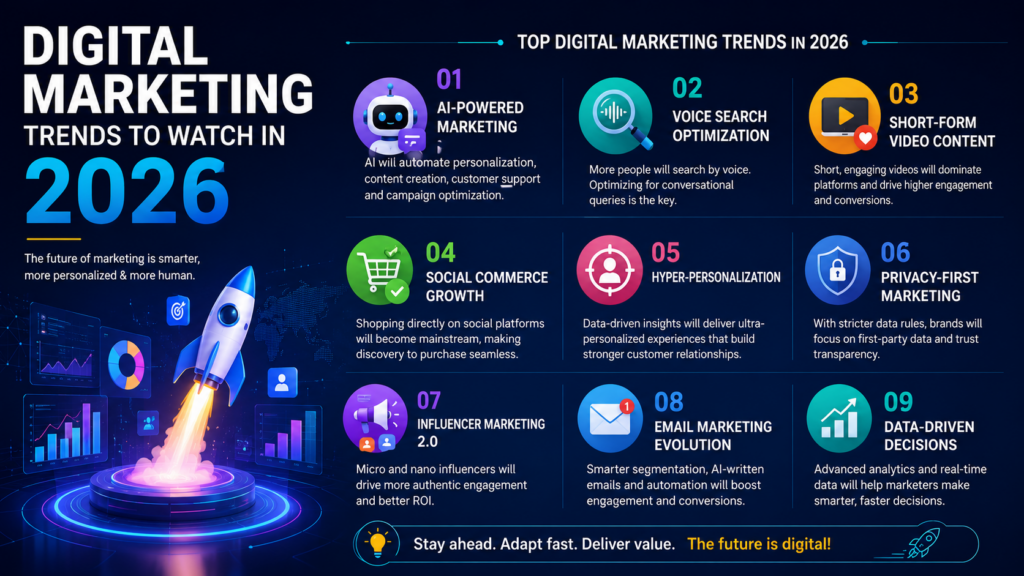
Digital marketing is changing rapidly as technology, search behavior, social media, and customer expectations continue to evolve. In 2026, businesses are not only competing for attention on Google and social media—they are also adapting to AI-powered search, personalized content, automation, social commerce, and new ways of discovering information online.
Artificial intelligence is becoming a major part of marketing workflows. Recent industry research identifies AI-powered personalization, automation, adapting SEO for changing search, and repurposing content across channels among the leading marketing trends for 2026.
For businesses and digital marketers, keeping up with these changes can create new opportunities to reach customers and build stronger online brands.
In this guide, we will explore the top digital marketing trends to watch in 2026 and how businesses can adapt their strategies.
1. Artificial Intelligence in Digital Marketing
Artificial Intelligence (AI) is one of the biggest digital marketing trends in 2026.
AI is increasingly being used to assist marketers with:
- Content creation
- Audience research
- Personalization
- Data analysis
- Campaign optimization
- Customer support
- Marketing automation
- Ad creative generation
- Predictive analysis
AI can help marketers complete repetitive tasks faster, allowing them to spend more time on strategy, creativity, and customer relationships.
Recent reporting also highlights growing demand for AI-generated marketing and media content.
How Businesses Can Use AI
Businesses can use AI to brainstorm content ideas, analyze campaign data, create content variations, personalize customer communication, and automate repetitive marketing tasks.
However, AI should be treated as a marketing assistant rather than a complete replacement for human judgment.
Human creativity, fact-checking, brand voice, and strategic decision-making remain important.
2. AI-Powered Search Is Changing SEO
Search engines are increasingly incorporating AI-generated answers and conversational experiences.
This means that traditional SEO is evolving.
Instead of users always clicking through a list of blue links, they may receive a direct AI-generated summary before deciding whether to visit a website.
Industry research in 2026 shows that marketers are actively adapting their SEO strategies to AI-powered search, with many businesses exploring approaches commonly described as Answer Engine Optimization (AEO).
What Does This Mean for Businesses?
Creating content that is:
- Helpful
- Accurate
- Well structured
- Easy to understand
- Relevant to search intent
- Supported by trustworthy information
is becoming increasingly important.
Businesses should focus on answering real customer questions rather than simply repeating keywords.
3. Search Is Moving Beyond Traditional Search Engines
People are increasingly discovering information through multiple platforms.
Search behavior can happen on:
- YouTube
- TikTok
- AI tools
- Online communities
Social media is increasingly functioning as a discovery and search channel, particularly for younger audiences.
This means businesses should not depend entirely on traditional Google SEO.
A strong strategy can combine:
SEO + Social Search + Video + Helpful Content + Brand Building
4. Short-Form Video Continues to Grow
Short-form video remains one of the most important content formats for digital marketers.
Platforms such as Instagram, YouTube, and other social networks provide businesses with opportunities to reach audiences through short videos.
Short-form videos can be used for:
- Educational tips
- Product demonstrations
- Tutorials
- Behind-the-scenes content
- Customer stories
- Industry insights
- Brand storytelling
Research on 2026 social media trends continues to identify short-form video as a major area of usage and investment.
Tips for Short-Form Video
Start with a strong hook.
For example:
“3 SEO mistakes that could be hurting your website.”
Then quickly explain the problem and provide useful information.
The goal should be to create content that people actually want to watch and share—not simply produce videos because they are trending.
5. Authenticity Is Becoming More Important
As AI makes it easier to create large amounts of content, audiences may place greater value on content that feels genuine and human.
Social media trends in 2026 indicate a shift toward more authentic content rather than overly polished posts.
Brands can build authenticity through:
- Real customer stories
- Behind-the-scenes content
- Founder-led videos
- Personal experiences
- Genuine opinions
- User-generated content
- Transparent communication
Why Does Authenticity Matter?
When audiences see too much repetitive or obviously automated content, genuinely useful and human content can stand out.
AI can help create content efficiently, but human perspective gives content personality.
6. Social Commerce Is Becoming More Important
Social media is increasingly becoming part of the customer shopping journey.
Instead of discovering a product on social media and then moving to another platform to research it, customers can increasingly discover, evaluate, and purchase products within social experiences.
Social commerce is therefore becoming an important opportunity for businesses selling products online.
Businesses can use:
- Product videos
- Creator collaborations
- Product demonstrations
- Shoppable content
- Customer reviews
- Live shopping
- Social advertisements
to help customers move from discovery toward purchase.
7. Creator and Influencer Marketing
Influencer marketing continues to evolve.
Instead of focusing only on celebrities or creators with millions of followers, brands are increasingly considering smaller creators with highly relevant and engaged audiences.
These creators are often called micro-influencers.
A creator with 20,000 highly relevant followers may provide more value to a niche brand than a creator with millions of followers who has little connection with the brand’s target audience.
What Brands Should Look For
When choosing a creator, consider:
- Audience relevance
- Engagement quality
- Content style
- Audience location
- Brand alignment
- Authenticity
The goal should be to find creators who genuinely connect with the target audience.
8. Personalization in Digital Marketing
Customers increasingly expect brands to provide relevant experiences.
Personalization means adapting content, recommendations, messages, or experiences based on customer information and behavior.
Examples include:
- Personalized emails
- Product recommendations
- Relevant advertisements
- Customized website experiences
- Audience-specific content
AI is making it easier for businesses to personalize marketing at scale. Industry research identifies AI-powered personalized content as a leading marketing trend in 2026.
However, businesses should use customer data responsibly and transparently.
9. Marketing Automation
Marketing automation allows businesses to automate repetitive tasks and workflows.
Examples include:
- Automated emails
- Lead nurturing
- Customer segmentation
- Campaign scheduling
- Follow-up messages
- Reporting
- Customer notifications
Automation can save time and allow marketers to focus on more strategic work.
Example
A visitor fills out a contact form on your website.
An automated system could:
- Store the lead.
- Send a confirmation email.
- Notify the sales team.
- Send relevant follow-up content.
- Track whether the person responds.
Automation can make marketing processes more efficient when implemented properly.
10. Content Repurposing
Creating content from scratch for every platform can take a lot of time.
Content repurposing means turning one piece of content into multiple formats.
For example, one blog post about SEO could become:
- An Instagram carousel
- A short video
- A LinkedIn post
- A YouTube video
- An infographic
- An email newsletter
This approach allows marketers to reach different audiences across different platforms while maintaining a consistent message.
Content repurposing is also identified among the important marketing trends for 2026.
11. Community Building
Building a community can be more valuable than simply collecting followers.
A strong community consists of people who actively interact with your brand, content, or shared interests.
Businesses can build communities through:
- Social media groups
- Online communities
- Email newsletters
- Events
- Discussion forums
- Creator communities
Community-focused marketing can create stronger relationships and encourage customers to become advocates for a brand.
12. Data-Driven Marketing
Marketing decisions are increasingly based on data rather than assumptions.
Marketers can use data to understand:
- Which content performs best
- Where website traffic comes from
- Which advertisements generate leads
- Which audiences convert
- Which products receive the most interest
- Which marketing channels provide the best results
Important metrics include:
- Website traffic
- Engagement rate
- Click-through rate
- Conversion rate
- Cost per lead
- Customer acquisition cost
- Return on advertising spend
The goal is not to collect as much data as possible. It is to collect useful data and use it to make better decisions.
13. Human Creativity + AI
One of the most important lessons of 2026 is that AI and human creativity do not necessarily need to compete.
AI can help with:
Speed + Automation + Analysis + Personalization
Humans provide:
Creativity + Strategy + Judgment + Emotion + Brand Personality
Current marketing discussions increasingly emphasize a human-led approach supported by AI rather than relying on automation alone.
The strongest digital marketing strategies are likely to combine both.
How to Prepare Your Digital Marketing Strategy for 2026
Businesses do not need to adopt every new trend.
Instead, focus on trends that match your audience and goals.
Step 1: Improve Your Website
Make sure your website is:
- Fast
- Mobile-friendly
- Easy to navigate
- Secure
- Useful
- Well structured
Step 2: Create Helpful Content
Focus on answering real customer questions.
Step 3: Optimize for Search
Continue investing in SEO while adapting your content for AI-powered search experiences.
Step 4: Use Short-Form Video
Experiment with educational and entertaining videos that match your brand.
Step 5: Explore AI Tools
Use AI to improve productivity while maintaining human review and creativity.
Step 6: Build Your Social Presence
Choose the social platforms where your target audience is most active.
Step 7: Track Your Results
Measure performance and invest more in strategies that produce meaningful business results.
Digital Marketing Trends 2026: Quick Summary
| Trend | Why It Matters |
|---|---|
| AI Marketing | Improves productivity and personalization |
| AI Search | Changes how users discover information |
| Social Search | Expands discovery beyond Google |
| Short-Form Video | Helps brands capture attention |
| Authentic Content | Builds trust and connection |
| Social Commerce | Connects discovery with purchasing |
| Creator Marketing | Helps brands reach niche audiences |
| Personalization | Makes marketing more relevant |
| Automation | Saves time and improves efficiency |
| Content Repurposing | Maximizes content value |
| Community Building | Creates stronger customer relationships |
| Data-Driven Marketing | Improves decision-making |
Common Mistakes to Avoid in 2026
Chasing Every Trend
Not every trend is suitable for every business.
Choose strategies based on your audience and objectives.
Depending Completely on AI
AI can produce content quickly, but blindly publishing AI-generated material can lead to inaccurate, repetitive, or generic content.
Ignoring Human Creativity
People connect with stories, experiences, opinions, and emotions.
Do not remove the human element from your brand.
Focusing Only on Followers
Follower numbers do not automatically translate into customers.
Focus on relevant engagement, leads, conversions, and business outcomes.
Ignoring Search Changes
Search is evolving rapidly. Businesses should continue learning about AI-powered search and adapting their SEO strategies.
Conclusion
The digital marketing trends of 2026 show that the industry is becoming more AI-powered, personalized, automated, visual, and community-driven.
Artificial intelligence is changing how marketers create content and analyze data, while AI-powered search is changing how people discover information. At the same time, short-form video, social commerce, creator marketing, authentic content, and community building continue to provide opportunities for brands.
However, technology alone will not guarantee marketing success.
The brands that stand out will be those that combine AI and automation with human creativity, useful content, authenticity, strong customer relationships, and data-driven decision-making.
If you are building your digital marketing strategy in 2026, start by understanding your audience, choose the trends that fit your business, experiment with new tools, measure your results, and keep improving.
The future of digital marketing is not simply about using more technology—it is about using technology intelligently while keeping people at the center of your marketing strategy.
Frequently Asked Questions
What are the biggest digital marketing trends in 2026?
Some major trends include AI-powered marketing, AI search, social search, short-form video, personalization, marketing automation, social commerce, creator marketing, and community building.
How is AI changing digital marketing?
AI is helping marketers with content creation, personalization, data analysis, campaign optimization, automation, and other repetitive tasks.
Is SEO still important in 2026?
Yes. SEO remains important, but marketers increasingly need to consider AI-powered search and answer-engine experiences in addition to traditional search results.
Is social media important for digital marketing in 2026?
Yes. Social media remains one of the major digital marketing channels, with social search, short-form video, social commerce, and creator marketing becoming increasingly important.
Should businesses use AI-generated content?
AI can be useful for brainstorming, drafting, personalization, and productivity. However, businesses should review content for accuracy, originality, usefulness, and brand voice before publishing.