
Introduction
In today’s competitive online environment, having a website is not enough to grow a business. Customers use Google, social media, videos, websites, email, and online advertisements to discover and evaluate businesses.
This is why having a strong digital marketing strategy is essential.
Digital marketing strategies help businesses reach their target audience, increase brand awareness, generate qualified leads, build customer relationships, and increase sales. Whether you run a small business, startup, personal brand, or established company, the right online marketing strategies can help you build a stronger presence on the internet.
In this blog, we will explore 10 effective digital marketing strategies to grow your business and explain how you can use them to improve your online visibility and achieve sustainable business growth.
What Is a Digital Marketing Strategy?
A digital marketing strategy is a planned approach for promoting a business, product, service, or brand using digital channels.
A strategy typically includes:
- Identifying your target audience
- Setting marketing goals
- Choosing the right digital channels
- Creating valuable content
- Promoting your brand
- Tracking performance
- Improving campaigns based on results
Instead of randomly posting content or running advertisements, a clear strategy helps you focus your time and budget on activities that support your business objectives.
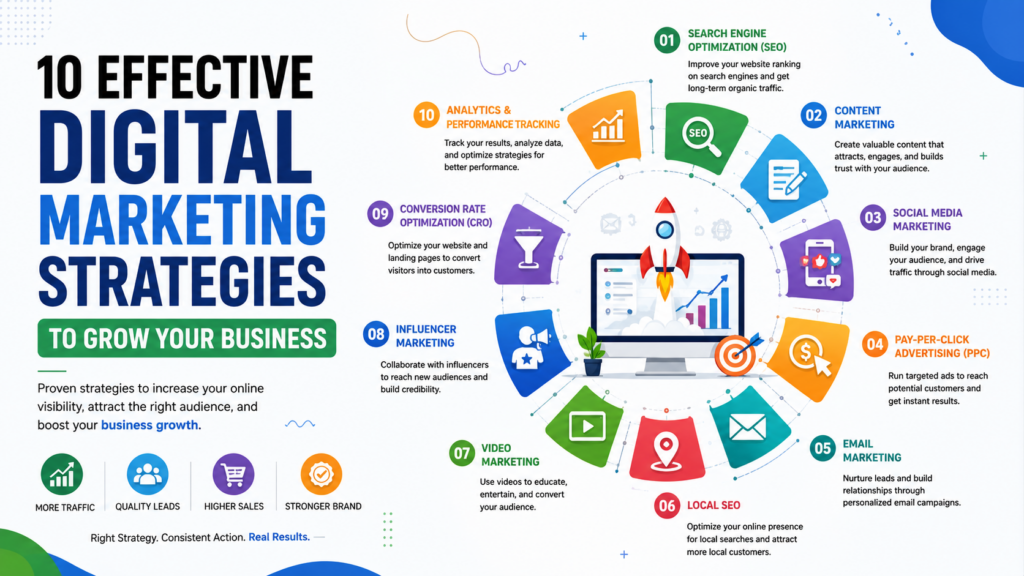
10 Digital Marketing Strategies to Grow Your Business
1. Search Engine Optimization (SEO)
Search Engine Optimization (SEO) is one of the most important long-term digital marketing strategies.
SEO involves improving your website and content so that search engines can better understand your pages and users can find your business when searching for relevant information, products, or services.
Important SEO activities include:
- Keyword research
- On-page SEO
- Technical SEO
- Content optimization
- Internal linking
- Image optimization
- Mobile optimization
- Improving website speed
- Building quality backlinks
For example, if you provide digital marketing services, you could create useful content targeting relevant searches such as digital marketing services, SEO services, or social media marketing tips.
Why SEO Matters
A well-optimized website can attract relevant organic traffic over time. Unlike paid advertising, you do not generally pay for every organic click, although SEO requires ongoing effort, content creation, and optimization.
2. Content Marketing
Content marketing focuses on creating useful, relevant, and valuable content for your target audience.
Instead of constantly promoting your products or services, you provide information that helps potential customers solve problems or make better decisions.
Content marketing can include:
- Blog posts
- Videos
- Infographics
- Guides
- Case studies
- E-books
- Social media posts
- Tutorials
For example, a web design company could publish a blog titled “How to Create a Professional Website for Your Small Business.”
People searching for this information may discover the company through the blog and later become potential customers.
Benefits of Content Marketing
Good content can help you:
- Build authority
- Increase website traffic
- Educate customers
- Improve SEO
- Generate leads
- Build trust
3. Social Media Marketing
Social media platforms provide businesses with an opportunity to connect directly with their audience.
Social media marketing involves creating and sharing content to build brand awareness, engagement, and relationships.
Depending on your target audience, you may use platforms such as:
- YouTube
- X
Your content strategy can include educational posts, short-form videos, customer testimonials, behind-the-scenes content, product demonstrations, and industry insights.
Tips for Social Media Marketing
- Post consistently
- Understand your audience
- Use engaging visuals
- Create short-form videos
- Respond to comments
- Encourage discussions
- Analyze your performance
The goal should not simply be to gain followers. Focus on attracting the right audience and creating meaningful engagement.
4. Pay-Per-Click (PPC) Advertising
Pay-Per-Click advertising allows businesses to promote their products or services through paid digital advertisements.
Search advertising can help your business appear when people search for relevant keywords. Social media advertising can also help you reach specific audiences based on various targeting options.
PPC can be useful when you want to generate targeted traffic relatively quickly.
A successful PPC campaign requires:
- Keyword research
- Audience targeting
- Effective ad copy
- Relevant landing pages
- Budget management
- Conversion tracking
- Continuous testing
For example, a local digital marketing agency could run advertisements targeting people searching for marketing services in its service area.
5. Email Marketing
Email marketing remains a useful strategy for building relationships with prospects and existing customers.
Businesses can use email campaigns to share:
- Newsletters
- Product updates
- Special offers
- Educational content
- Company announcements
- Personalized recommendations
Instead of sending the same message to everyone, businesses can segment their email lists based on customer interests and behavior.
How Email Marketing Helps Business Growth
Email marketing can help businesses nurture leads, maintain customer relationships, encourage repeat purchases, and keep their brand in front of potential customers.
The key is to provide useful content and avoid sending irrelevant messages too frequently.
6. Local SEO
If you operate a local business, Local SEO can help people discover your business when searching for products or services in a specific area.
For example, searches such as:
- Digital marketer near me
- Digital marketing agency in Mumbai
- SEO services near me
- Social media marketing services in Mumbai
have local intent.
Important local SEO activities include:
- Optimizing your business profile
- Keeping business information accurate
- Creating location-relevant website content
- Collecting genuine customer reviews
- Building relevant local citations
- Optimizing location pages
Local SEO can be especially valuable for restaurants, salons, clinics, agencies, retailers, and other businesses serving a specific geographic area.
7. Video Marketing
Video has become an important part of online marketing because it can communicate information quickly and visually.
Businesses can use videos for:
- Product demonstrations
- Tutorials
- Educational content
- Customer testimonials
- Behind-the-scenes content
- Brand storytelling
- Short-form videos
Platforms such as YouTube, Instagram, and other social networks provide opportunities to reach new audiences through video.
Tips for Video Marketing
Keep your videos focused on one clear topic. Start with an interesting hook, provide useful information, and include a simple call to action when appropriate.
You do not always need expensive equipment. A smartphone, good lighting, clear audio, and useful content can be enough to get started.
8. Influencer Marketing
Influencer marketing involves collaborating with creators who have an established audience within a particular niche.
For example, a fitness brand may collaborate with a fitness creator, while a technology company may work with a technology-focused creator.
When selecting an influencer, consider:
- Audience relevance
- Engagement quality
- Content style
- Brand alignment
- Audience location
- Authenticity
A smaller creator with a highly relevant and engaged audience may sometimes be more useful than a creator with a large but unrelated audience.
9. Conversion Rate Optimization (CRO)
Getting website visitors is only one part of digital marketing. You also need to encourage visitors to take meaningful actions.
Conversion Rate Optimization (CRO) focuses on improving a website or landing page so that a higher percentage of relevant visitors complete a desired action.
Conversions can include:
- Purchasing a product
- Filling out a contact form
- Booking an appointment
- Requesting a quote
- Signing up for a newsletter
- Downloading a resource
You can improve conversions by:
- Using clear calls to action
- Simplifying forms
- Improving page speed
- Creating easy-to-understand content
- Adding relevant trust signals
- Improving mobile usability
- Testing different page elements
A website with high traffic but poor conversion performance may not generate strong business results.
10. Analytics and Performance Tracking
One of the most important digital marketing strategies is measuring your results.
Analytics helps you understand which channels and campaigns are producing meaningful outcomes.
Important metrics can include:
- Website traffic
- Organic traffic
- Click-through rate
- Engagement rate
- Leads
- Conversion rate
- Cost per lead
- Customer acquisition cost
- Return on advertising spend
- Revenue
For example, if your website receives thousands of visitors but generates very few inquiries, you may need to improve your landing pages, calls to action, content, or overall user experience.
Why Analytics Matters
Without measurement, it is difficult to know whether your marketing strategy is working.
Tracking data allows you to identify successful campaigns, discover weaknesses, and make better marketing decisions.
How to Choose the Right Digital Marketing Strategy
You do not need to use every digital marketing channel at the same time.
The best strategy depends on your:
- Business type
- Target audience
- Marketing goals
- Budget
- Industry
- Location
- Available resources
For example:
| Business Goal | Recommended Strategy |
|---|---|
| Increase organic traffic | SEO + Content Marketing |
| Build brand awareness | Social Media + Video Marketing |
| Generate leads quickly | PPC + Landing Pages |
| Build customer relationships | Email Marketing |
| Attract local customers | Local SEO |
| Improve website conversions | CRO + Analytics |
A focused strategy is often more effective than trying to manage every platform simultaneously.
How to Create a Digital Marketing Plan
Follow these steps to create a practical online marketing strategy.
Step 1: Define Your Goal
Decide what you want to achieve.
Your goal could be increasing sales, generating leads, increasing website traffic, building brand awareness, or improving customer retention.
Step 2: Understand Your Audience
Research your ideal customers and understand their problems, interests, needs, and online behavior.
Step 3: Research Your Competitors
Analyze competitors’ websites, social media profiles, content, SEO, advertisements, and offers.
Look for opportunities to provide something better or different.
Step 4: Select Your Channels
Choose the digital marketing channels that are most relevant to your audience and goals.
Step 5: Create Valuable Content
Develop content that answers customer questions, solves problems, and demonstrates your expertise.
Step 6: Promote Your Content
Use SEO, social media, email, paid advertising, or other suitable channels to distribute your content.
Step 7: Measure Performance
Track important metrics and compare your results with your goals.
Step 8: Optimize Your Strategy
Digital marketing requires continuous improvement. Test different approaches and invest more effort in strategies that produce meaningful results.
Common Digital Marketing Mistakes to Avoid
Even a well-planned campaign can underperform when basic mistakes are made.
1. Targeting Everyone
Trying to market to everyone can make your message too general. Define a specific target audience.
2. Ignoring SEO
If your website is not optimized for search engines, you may miss opportunities to attract organic traffic.
3. Posting Without a Strategy
Random social media posts may generate activity but not necessarily business results. Every piece of content should support a broader goal.
4. Focusing Only on Followers
A large follower count does not automatically mean more customers. Focus on relevant engagement, leads, conversions, and business outcomes.
5. Not Measuring Results
Without analytics, you cannot accurately evaluate your marketing performance.
6. Expecting Instant Results
Some strategies, particularly SEO and content marketing, take time to build momentum. Consistency and optimization are essential.
Why Digital Marketing Is Important for Small Businesses
Small businesses often compete with larger brands that have bigger marketing budgets. Digital marketing can provide smaller businesses with opportunities to reach specific audiences without relying entirely on expensive traditional advertising.
For example, a local business can combine:
Local SEO + Social Media + Content Marketing + Customer Reviews
to improve its online visibility and attract relevant customers.
A small business can also start with a limited budget and gradually increase investment as it identifies strategies that generate positive results.
Final Thoughts
Digital marketing is not about using as many platforms as possible. It is about reaching the right audience with the right message through the right channels.
The 10 digital marketing strategies discussed in this guide—SEO, content marketing, social media marketing, PPC, email marketing, local SEO, video marketing, influencer marketing, conversion rate optimization, and analytics—can work together to create a strong online marketing strategy.
Start with your business goals, understand your audience, choose the most relevant channels, create valuable content, and measure your performance regularly.
With consistent effort, testing, and optimization, digital marketing can help your business increase online visibility, attract potential customers, generate leads, and achieve sustainable business growth.
Frequently Asked Questions
What is the most effective digital marketing strategy?
There is no single strategy that works for every business. SEO, content marketing, social media, PPC, email marketing, and other channels can be effective depending on your audience, industry, goals, and budget.
How can digital marketing help a small business?
Digital marketing can help small businesses increase online visibility, reach targeted audiences, generate leads, communicate with customers, and promote products or services.
How long does digital marketing take to show results?
The timeframe depends on the strategy. Paid advertising can generate traffic quickly, while SEO and content marketing often require consistent effort and time to build organic visibility.
Is SEO important for digital marketing?
Yes. SEO can help businesses improve their visibility in search engines and attract relevant organic traffic to their websites.
Can I do digital marketing myself?
Yes. Beginners can learn digital marketing and start by working on their own website or social media profiles. As your skills improve, you can explore more advanced strategies and tools.